About GCATRED
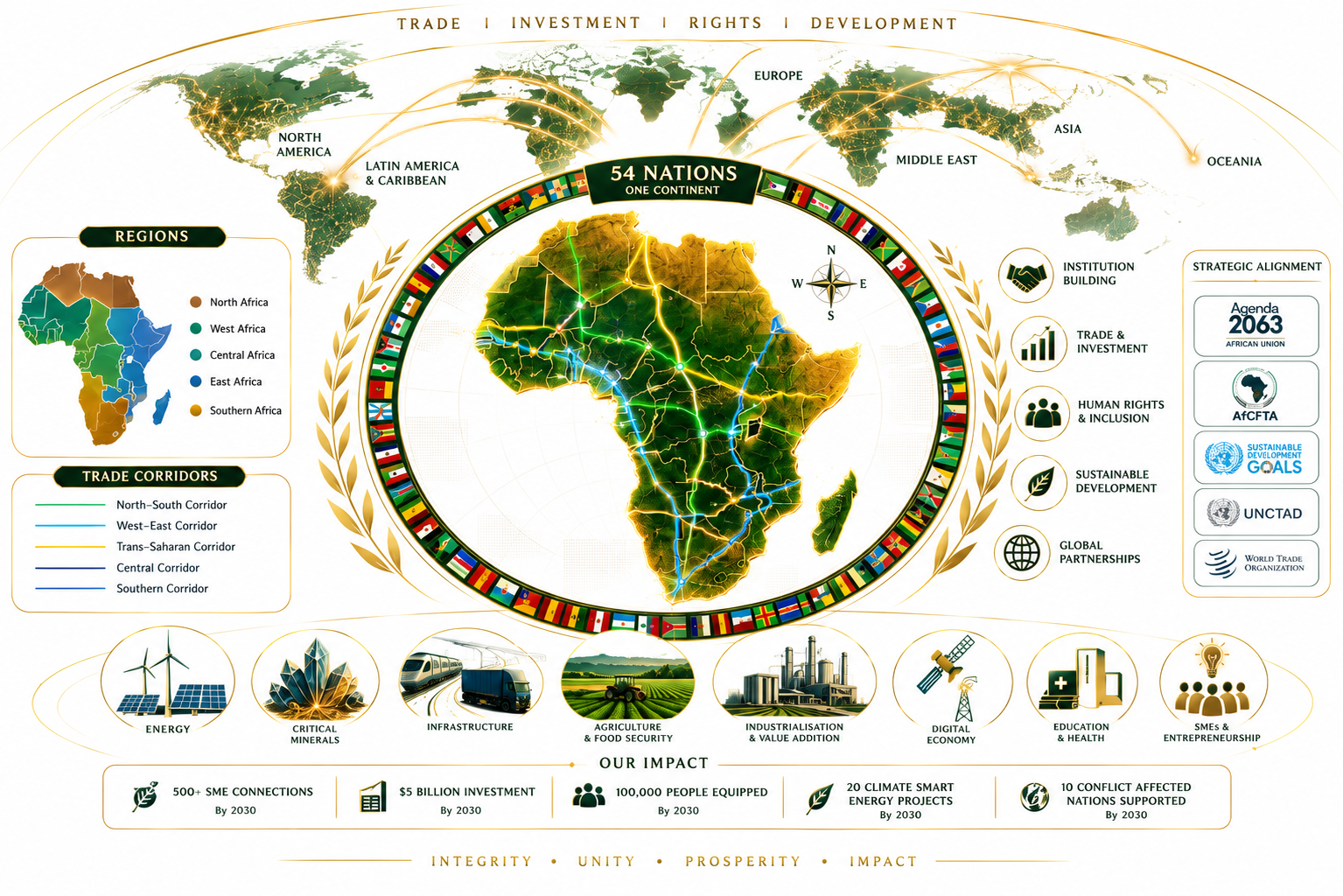
The Honest Infrastructure Africa Has Long Needed
GCATRED is an African founded, globally aligned institution connecting 54 nations through trade, investment and human rights. We are a diplomatic and developmental platform built to bridge the continent’s vast potential with a global economy that must become more inclusive, ethical and sustainable.
Constitution
Approved by founders and governance bodies
Code of Conduct
Governed by an independent Monitoring, Ethics and Deontology Committee (MEDC)
Membership Framework
Structured across five categories, spanning individuals to governments
Subsidiary Investment Arm
GCATRED Consultancy Ltd, registered and operating from Sierra Leone
Strategic Plan
Publicly available with measurable targets and annual reporting
Transparency
Annual alignment and impact reports
(Digital dashboards Launching soon)
Our History
A Genesis Rooted in Africa's Aspirations
Africa entered the 21st century with undeniable momentum: the adoption of the African Union’s Agenda 2063, the operationalisation of the African Continental Free Trade Area (AfCFTA), and a growing global recognition that the continent’s demographic, resource and cultural wealth could no longer be overlooked.
Yet alongside this promise, structural obstacles persisted. Africa’s share of global trade hovered at approximately 3%, despite representing 17% of the world’s population. Intra-African trade stood at less than 16% of total continental trade, compared to intra-European trade at nearly 70%. Foreign direct investment into Africa, while growing, remained heavily concentrated in extractive sectors, often without sufficient community benefit, environmental safeguards or alignment with national development priorities.
It was in this context, a moment of both immense possibility and persistent inequity, that the Global Chamber on African Trade, Rights and Economic Development (GCATRED) was conceived. The founding conviction was simple yet powerful: Africa’s economic future must be designed, directed and defended by Africans, in partnership with the world but never subordinated to it.
Anchored in Africa’s own blueprints, the Constitutive Act of the African Union, Agenda 2063, the AfCFTA Agreement, the UN Sustainable Development Goals, UNCTAD principles and the WTO Trade Facilitation Agreement, GCATRED was designed not as an external body commenting on Africa’s trajectory but as an implementing partner of the continent’s own development agendas.
Our Institutional Framework
Governance, Structure and Accountability
Multi-Stakeholder Governance Model
Rather than a narrow trade association, GCATRED was structured to include governments, private sector entities, civil society, academia and development partners. Its governance architecture features a Presidential Team, an Executive Council, an Advisory Board Council and a Monitoring, Ethics and Deontology Committee (MEDC), ensuring checks and balances.
Integrated Rights Based Approach
GCATRED explicitly links trade and investment to human rights, labour standards, gender equality and social inclusion, recognising that sustainable economic growth cannot occur where rights are violated or communities are excluded.
Investment Execution Platform
Recognising that advocacy alone is insufficient, GCATRED established GCATRED Consultancy Ltd, a private limited liability company registered in Sierra Leone to serve as its investment execution platform. This subsidiary identifies, develops and manages bankable projects that align with the Chamber’s strategic mission.
Digital and Data Driven Operations
GCATRED committed to building digital trade platforms, AI driven market intelligence tools and public dashboards to track progress against its 2030 targets, ensuring transparency and evidence based advocacy.
Our Governance Structures
Institution Building, Not Rhetoric
| Governance Element | Description |
|---|---|
| Constitution | Approved by its founders and governance bodies |
| Code of Conduct | Governed by an independent Monitoring, Ethics and Deontology Committee (MEDC) |
| Membership Framework | Structured across five categories, spanning individuals to governments |
| Subsidiary Investment Arm | GCATRED Consultancy Ltd, registered and operating from Sierra Leone |
| Strategic Plan | Publicly available with measurable targets and annual reporting |
| Transparency | Digital dashboards and annual alignment and impact reports |
Our Strategic Objectives
Our 2030 Vision, Public. Measured. Honest.
500+ African SMEs Connected
To global markets through trade facilitation and digital platforms
By 2030
$5 Billion Mobilised
In ethical, sustainable investments tracked transparently
By 2030
100,000 People Equipped
With leadership and entrepreneurial skills
By 2030
20 Climate Smart Energy Projects
Across the continent
By 2030
10 Conflict Affected Nations Supported
Through trade and dialogue
By 2030
Disclaimer
These are our commitments, not our achievements. Progress will be published annually, with independent audits, from 2026.
Our Founding Principles
Six Enduring Principles
01 Economic Sovereignty
Africa must own and direct its development trajectory.
02 Inclusive Prosperity
Growth that excludes women, youth or marginalised communities is incomplete.
03 Rights Based Development
Trade and investment are means to an end: the full realisation of human, social and economic rights.
04 Pan-African Unity
A fragmented Africa cannot negotiate, trade or lead effectively in the global arena.
05 Global Collaboration
Africa’s prosperity is linked to the world’s, we seek partners, not patrons.
06 Intergenerational Responsibility
We build for the Africa of 2063 and beyond, not for short term gain.
Our Strategic Alignment
Aligned with the Continent's Own Blueprints
GCATRED’s founding documents and strategic plans are explicitly aligned with and actively support Africa’s own development frameworks, not as a claim of partnership, but as a public commitment to the continent’s aspirations.
01 Economic Sovereignty
| Framework | GCATRED Alignment |
|---|---|
| African Union Agenda 2063 | Aspirations 1 (A Prosperous Africa), 2 (An Integrated Continent), and 4 (A Peaceful and Secure Africa) |
| African Continental Free Trade Area (AfCFTA) | Trade facilitation, SME integration and policy advocacy |
| UN Sustainable Development Goals (SDGs) | SDGs 1, 5, 8, 9, 10, 13, 16 and 17 |
| UNCTAD Principles | Fair, transparent and inclusive trade practices |
| WTO Trade Facilitation Agreement | Reduction of non-tariff barriers and customs modernisation |
Disclaimer
These alignments are consistent with these frameworks. They do not imply formal partnership with or endorsement by these organisations. They form the backbone of GCATRED’s Strategic Objectives (2024-2028) and will be publicly reported in an Annual Alignment and Impact Report.