Our Work
Our Sectors of Focus
Comprehensive. Integrated. Impact Driven
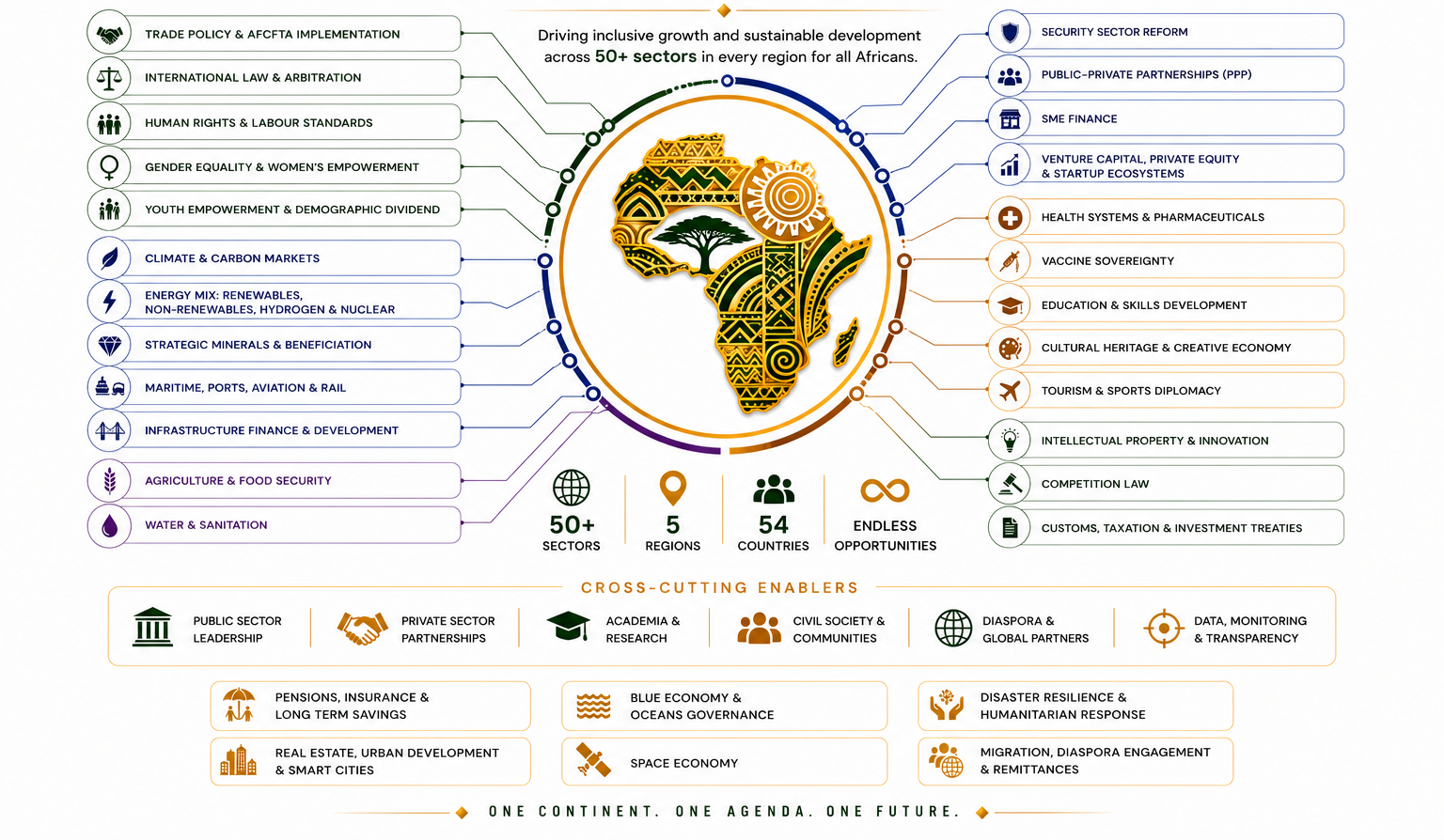
The Full Spectrum of Africa's Development Agenda
GCATRED’s work spans 50+ sectors across trade, investment, human rights, infrastructure, energy, technology, environment and culture, all aligned with the African Union’s Agenda 2063, the AfCFTA, and the UN Sustainable Development Goals. Our scope is wide because the challenge is wide.
Our Mandate
“We built GCATRED to be the honest infrastructure Africa has long needed, not another event, not another club, but a permanent platform where trade meets rights and where Africa speaks for itself.”
The Six Pillars of GCATRED
GCATRED’s strategic mandate is built on six interconnected pillars that together form a comprehensive framework for Africa’s inclusive and sustainable development.
Fair and Inclusive Trade
Expanding Africa’s global market share while connecting SMEs, women and youth to real opportunities under the AfCFTA. Working with governments to remove trade barriers and with entrepreneurs to build businesses that last.
Ethical Investment
Mobilising $5 billion in ESG screened, community centred investment by 2030, transparently tracked. Working with investors to deploy capital responsibly and with communities to ensure prosperity reaches the last mile.
Innovation and Digital Access
Equipping 1 million African entrepreneurs with digital platforms, skills and access to the global digital economy. Building digital trade platforms, AI driven market intelligence tools and public dashboards for transparency.
Human and Economic Rights
Safeguarding labour rights, gender equality, access to healthcare and social protection in 25 African nations. Linking trade and investment to human rights, labour standards and social inclusion.
Peace, Security and Stability
Mediating trade disrupting conflicts and supporting 30 conflict-sensitive investments in fragile regions. A fragmented Africa cannot negotiate, trade or lead effectively in the global arena.
Culture, Heritage and Identity
Launching 20 flagship cultural initiatives that celebrate Africa’s creativity and preserve its heritage. Culture, heritage and identity are not just symbols of our past, they are drivers of economic growth.
Sector Expertise
50+ Sectors Across Africa's Development Agenda
GCATRED’s sector coverage spans the full breadth of Africa’s economic transformation, from agriculture to the space economy, from trade policy to cultural heritage. Our scope is wide because the challenge is wide.
Trade and Investment
| Sector | Description |
|---|---|
| Trade Policy | AfCFTA implementation, trade facilitation, customs modernisation |
| International Law | Arbitration, dispute resolution, investment treaties |
| Investment Structuring | Cross-border investment, treaty negotiation, deal structuring |
| Public-Private Partnerships | PPP frameworks, project financing, infrastructure delivery |
| SME Finance | Venture capital, private equity, startup ecosystems, access to finance |
| Competition Law | Market regulation, anti-trust, consumer protection |
| Trade Facilitation | Non-tariff barrier reduction, single windows, corridor management |
Rights and Social Inclusion
| Sector | Description |
|---|---|
| Human Rights | Labour rights, social protection, legal reform, anti-discrimination |
| Gender Equality | Women’s economic empowerment, gender mainstreaming, equality initiatives |
| Youth Empowerment | Youth entrepreneurship, skills development, demographic dividend |
| Diaspora Engagement | Remittances, diaspora investment, knowledge transfer, migration |
| Health Systems | Healthcare infrastructure, pharmaceutical manufacturing, vaccine sovereignty |
| Education | Skills development, teacher training, curriculum reform, cultural heritage |
| Social Protection | Safety nets, social security, vulnerable populations, disability rights |
| Inclusion | Marginalised communities, accessibility, equity, non-discrimination |
Infrastructure and Energy
| Sector | Description |
|---|---|
| Maritime | Ports, shipping, maritime law, ocean governance, blue economy |
| Aviation | Airports, airlines, air transport, aviation policy |
| Rail | Railways, logistics hubs, trade corridors, rolling stock |
| Infrastructure Finance | Project financing, PPPs, infrastructure bonds, development finance |
| Energy Mix | Renewables, non-renewables, hydrogen, nuclear, energy transition |
| Water & Sanitation | Water supply, sanitation, hygiene, wastewater management |
| Urban Development | Smart cities, real estate, housing, urban planning |
| Telecommunications | Broadband, mobile networks, connectivity, universal access |
Resources and Environment
| Sector | Description |
|---|---|
| Strategic Minerals | Mining, beneficiation, critical minerals, resource governance |
| Blue Economy | Fisheries, aquaculture, marine resources, oceans governance |
| Space Economy | Satellite technology, space law, space exploration, astronomy |
| Climate | Climate finance, carbon markets, climate adaptation, resilience |
| Disaster Resilience | Humanitarian response, disaster risk reduction, early warning |
| Agriculture | Food security, commercial farming, agro-processing, value chains |
| Forestry | Land management, reforestation, timber, conservation |
| Environment | Conservation, biodiversity, sustainability, pollution control |
Technology and Innovation
| Sector | Description |
|---|---|
| Digital Transformation | Digitisation, AI, data governance, cybersecurity, digital readiness |
| E-Commerce | Digital trade, online marketplaces, payment systems, consumer protection |
| Fintech | Digital finance, mobile money, blockchain, financial inclusion |
| Artificial Intelligence | AI governance, machine learning, automation, data ethics |
| Innovation | Startups, incubators, accelerators, technology parks, R&D |
| Digital Trade | Cross-border e-commerce, digital trade facilitation, data flows |
Cross-Cutting
| Sector | Description |
|---|---|
| Pensions | Retirement savings, pension funds, long-term savings, social security |
| Insurance | Risk management, insurance markets, micro-insurance, reinsurance |
| Security Sector Reform | Governance, rule of law, justice systems, security sector development |
| Tourism | Travel, hospitality, eco-tourism, sports diplomacy, tourism policy |
| Creative Economy | Arts, culture, entertainment, film, music, sports, cultural heritage |
| Intellectual Property | IP protection, copyright, trademarks, patents, innovation rights |
| Public Financial Management | Budgeting, taxation, revenue collection, fiscal policy |
Trade Corridors
The Physical Infrastructure of African Integration
Trade corridors are the arteries of Africa’s economy, connecting producers to markets, resources to industries, and people to opportunity. GCATRED works across 20+ major corridors spanning all five African regions.
Multi-Stakeholder Governance Model
Rather than a narrow trade association, GCATRED was structured to include governments, private sector entities, civil society, academia and development partners. Its governance architecture features a Presidential Team, an Executive Council, an Advisory Board Council and a Monitoring, Ethics and Deontology Committee (MEDC), ensuring checks and balances.
Integrated Rights Based Approach
GCATRED explicitly links trade and investment to human rights, labour standards, gender equality and social inclusion, recognising that sustainable economic growth cannot occur where rights are violated or communities are excluded.
Investment Execution Platform
Recognising that advocacy alone is insufficient, GCATRED established GCATRED Consultancy Ltd, a private limited liability company registered in Sierra Leone to serve as its investment execution platform. This subsidiary identifies, develops and manages bankable projects that align with the Chamber’s strategic mission.
Digital and Data Driven Operations
GCATRED committed to building digital trade platforms, AI driven market intelligence tools and public dashboards to track progress against its 2030 targets, ensuring transparency and evidence based advocacy.
African Trade Corridors
The Physical Infrastructure of African Integration
Trade corridors are the arteries of Africa’s economy, connecting producers to markets, resources to industries, and people to opportunity. GCATRED works across 20+ major corridors spanning all five African regions.
West Africa Corridors
Corridor 1, Abidjan-Lagos Corridor
Countries: Côte d’Ivoire, Ghana, Togo, Benin, Nigeria
Key Sectors: Trade, logistics, manufacturing
Significance: West Africa’s most important trade route
Corridor 2, Abidjan-Ouagadougou Corridor
Countries: Côte d’Ivoire, Burkina Faso
Key Sectors: Agriculture, mining, transport
Significance: Connecting landlocked Burkina Faso to coastal ports
Corridor 3, Dakar-Abidjan Corridor
Countries: Senegal, Mali, Guinea, Côte d’Ivoire
Key Sectors: Transport, trade, agriculture
Significance: Pan-West African connectivity
Corridor 4, Tema-Ouagadougou Corridor
Countries: Ghana, Burkina Faso
Key Sectors: Agriculture, trade, transport
Significance: Alternative route for landlocked Burkina Faso
Eastern Africa Corridors
Corridor 5, Northern Corridor
Countries: Kenya, Uganda, Rwanda, Burundi, DRC, South Sudan
Key Sectors: Transport, logistics, trade
Significance: East Africa’s busiest trade corridor
Corridor 6, Dar es Salaam Corridor
Countries: Tanzania, DRC, Zambia, Malawi
Key Sectors: Port, logistics, mining
Significance: Gateway to landlocked southern and central Africa
Corridor 7, Central Corridor
Countries: Tanzania, Rwanda, Burundi, DRC
Key Sectors: Transport, trade, agriculture
Significance: Connecting the Great Lakes region to the Indian Ocean
Corridor 8, Ethiopia-Djibouti Corridor
Countries: Ethiopia, Djibouti
Key Sectors: Port, logistics, trade
Significance: Ethiopia’s primary trade route
Southern Africa Corridors
Corridor 9, Walvis Bay Corridor
Countries: Namibia, Zambia, DRC
Key Sectors: Port, logistics, mining
Significance: Atlantic Ocean gateway for southern Africa
Corridor 10, Lobito-Great Lakes Corridor
Countries: Angola, DRC, Zambia
Key Sectors: Mining, transport, agriculture
Significance: Connecting Atlantic and Indian Ocean trade routes
Corridor 11, North-South Corridor
Countries: South Africa, Zimbabwe, Zambia, DRC
Key Sectors: Transport, trade, mining
Significance: Africa’s longest trade corridor
Corridor 12, Maputo Development Corridor
Countries: South Africa, Mozambique
Key Sectors: Port, logistics, energy
Significance: Industrial corridor connecting Gauteng to the Indian Ocean
Central Africa Corridors
Corridor 13, Douala-Ndjamena Corridor
Countries: Cameroon, Chad
Key Sectors: Transport, trade, agriculture
Significance: Chad’s primary trade route
Corridor 14, Pointe Noire-Brazzaville Corridor
Countries: Congo
Key Sectors: Port, logistics, forestry
Significance: Congo’s primary export route
North Africa Corridors
Corridor 15, Trans-Maghreb Corridor
Countries: Morocco, Algeria, Tunisia, Libya
Key Sectors: Transport, trade, energy
Significance: North Africa’s integration spine
Corridor 16, Algiers-Lagos Corridor
Countries: Algeria, Niger, Nigeria
Key Sectors: Transport, energy, trade
Significance: Trans-Saharan connectivity
Key Programmes
Flagship Initiatives Driving Africa's Transformation
Africa Global Trade and Investment Forum (AGTIF)
Africa’s premier annual gathering connecting Heads of State, business leaders, investors and innovators to advance trade, investment and sustainable development across the continent.
GCATRED Business and Leadership Fellowship (GBLF)
A transformative leadership programme equipping Africa’s next generation of leaders with the skills, networks and capital to drive inclusive economic growth and sustainable development.
Africa Ethical Investment and SDG Forum
A platform connecting ethical investors with bankable, ESG screened projects across Africa, advancing the UN Sustainable Development Goals through responsible capital deployment.
Strategic Alignment
Aligned with the Continent's Own Blueprints
GCATRED’s work is explicitly aligned with Africa’s own development frameworks. These alignments are not for prestige, they form the backbone of our Strategic Objectives (2024-2028), are monitored through digital dashboards, and are publicly reported in our Annual Alignment & Impact Report.
| Framework | GCATRED Alignment |
|---|---|
| African Union Agenda 2063 | Aspirations 1 (A Prosperous Africa), 2 (An Integrated Continent), and 4 (A Peaceful and Secure Africa) |
| African Continental Free Trade Area (AfCFTA) | Trade facilitation, SME integration and policy advocacy |
| UN Sustainable Development Goals (SDGs) | SDGs 1, 5, 8, 9, 10, 13, 16 and 17 |
| UNCTAD Principles | Fair, transparent and inclusive trade practices |
| WTO Trade Facilitation Agreement | Reduction of non-tariff barriers and customs modernisation |
Disclaimer
These alignments are consistent with these frameworks. They do not imply formal partnership with or endorsement by these organisations.